

Nigerian fintech company Moniepoint says it processed transactions worth ₦412 trillion across more than 14 billion transactions in 2025. The company also reported that its payment terminals handled eight out of every 10 in-person payments in Nigeria, highlighting its role in the country’s digital payments market.
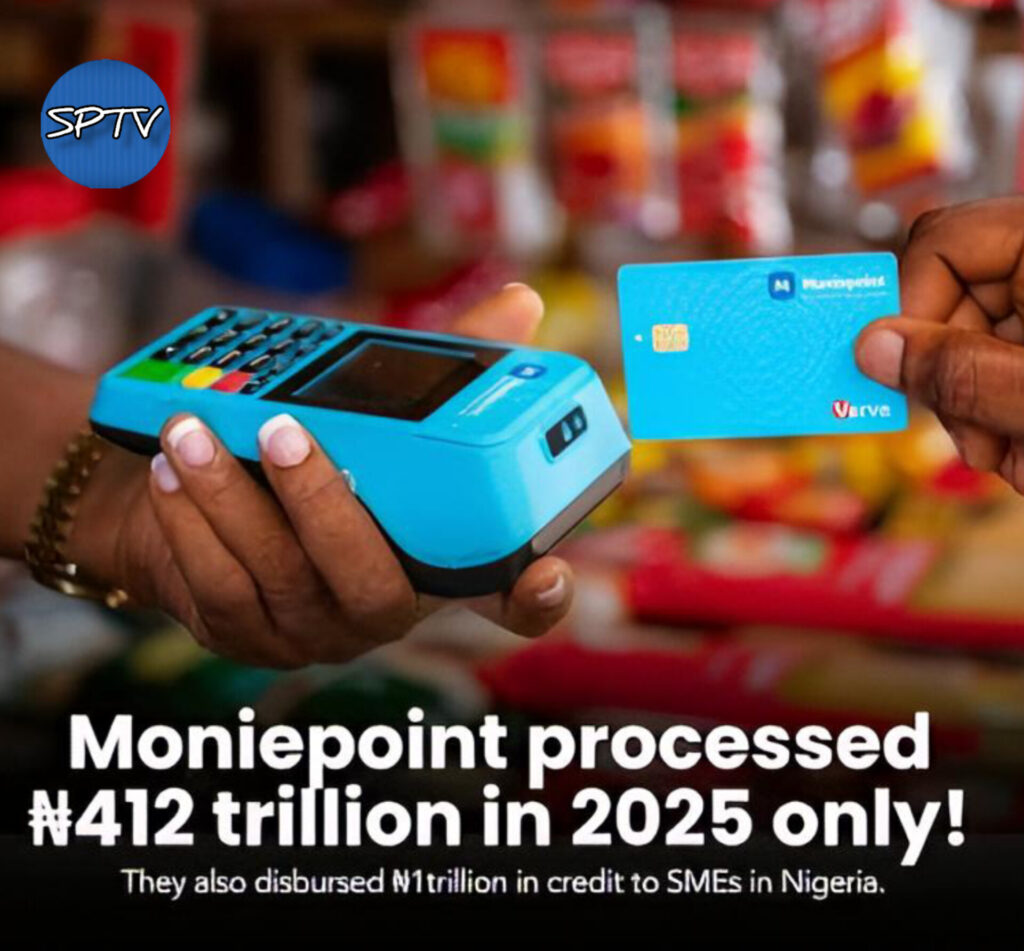
The figures appeared in Moniepoint’s 2025 Year in Review, which marked the company’s tenth year of operations. According to the report, Moniepoint served more than six million businesses, while its microfinance bank disbursed over ₦1 trillion in credit to small businesses during the year.
The company also reported that businesses receiving credit recorded an average 36% increase in transaction value after accessing loans. Its online payment gateway, Monnify, processed transactions worth ₦25 trillion over the same period.
These figures offer a picture of how extensively Moniepoint’s services are used by Nigerian businesses. However, the numbers are company-reported figures from its annual review and should be understood in that context.
Moniepoint Reports ₦412 Trillion in Transactions
Moniepoint said its banking and payments operations processed ₦412 trillion in transaction value during 2025. The company also reported handling more than 14 billion transactions over the year.
The value represents the total amount moved through the company’s payment infrastructure, not the company’s revenue or profit. This distinction is important because a payment provider can process large sums on behalf of customers and businesses without earning that entire amount as income.
TechCabal reported that the ₦412 trillion was equivalent to approximately $294 billion using the exchange-rate conversion in its coverage. Another article used a figure close to $297 billion, showing why the naira amount is the clearest figure to use when comparing the company’s reported transaction activity.
The more than 14 billion transactions also indicate the frequency with which customers and businesses used Moniepoint’s services. The total includes a large number of payments across the company’s financial ecosystem, rather than a single type of transaction.
The figures reflect Moniepoint’s growing place in Nigeria’s payment sector, where digital transfers and point-of-sale payments are widely used by retailers, service providers and other businesses.
Moniepoint Says It Handles 8 Out of 10 In-Person Payments
One of the most notable claims in the 2025 report is that eight out of every 10 in-person payments in Nigeria are made on a Moniepoint terminal.
The company describes itself as a major merchant acquirer, connecting businesses to payment services that allow them to accept digital payments from customers. Its terminals are used by businesses that need to receive payments without relying exclusively on cash.
These businesses include shops, restaurants, pharmacies, supermarkets and other merchants that sell goods or services directly to customers.
For a retailer, a point-of-sale terminal can provide another way to accept payment when a customer does not have cash available. It can also help businesses record transactions and manage sales more efficiently.
However, Moniepoint’s eight-in-10 figure should be attributed to the company rather than treated as an independently verified share of every type of payment in Nigeria. The company’s claim refers to in-person payments, which are not the same as all bank transfers, online purchases or digital financial transactions nationwide.
The distinction matters because Nigeria’s payment market includes many channels and providers. Moniepoint’s reported position in physical payments does not mean that it processes eight out of every 10 transactions across the entire financial system.
More Than 6 Million Businesses Use Moniepoint
Moniepoint reported serving more than six million businesses in its 2025 Year in Review.
Its business-focused services include payment acceptance, business accounts, credit and tools intended to support daily operations. The company has expanded beyond its earlier role as a technology provider to banks and developed a broader financial platform for businesses.
Many small businesses need reliable ways to collect customer payments, pay suppliers and keep money moving through their operations. Digital payment services can help merchants receive payments electronically and reduce their dependence on cash-only transactions.
For businesses that make frequent sales, access to payment infrastructure can also help them keep transaction records and understand the movement of funds through their accounts.
Moniepoint’s reported customer base suggests that its services have reached a substantial number of businesses. Still, the number of businesses served does not necessarily mean every business uses every product offered by the company or uses its services at the same frequency.
The figure is best understood as a measure of the company’s reported business reach, rather than a direct measure of its revenue or the profitability of the businesses using its services.
Moniepoint Disbursed More Than ₦1 Trillion in Small-Business Loans
Moniepoint said its microfinance bank disbursed more than ₦1 trillion in credit to small businesses in 2025.
According to the company’s report, the borrowers included businesses such as provision stores, supermarkets and building materials sellers. These types of businesses often need working capital to restock products, manage operating expenses or respond to changes in customer demand.
Access to credit can help a business pay for stock or other business needs before it has collected all the money expected from sales. However, a loan also creates a repayment obligation, so businesses need to consider the cost of borrowing and their ability to repay.
Moniepoint says its lending model uses information such as transaction histories, business patterns and payment behaviour to help assess credit applications. The company presents this approach as a way to assess businesses that may not fit conventional credit-scoring methods.
The reported ₦1 trillion figure refers to the credit disbursed during the period, not the amount of money the company earned from lending. Loan disbursements, outstanding loan balances and interest income are different financial measures.
The report does not mean every small business in Nigeria received credit or that all borrowers experienced the same results. The outcome for an individual business depends on its circumstances, the loan terms and how the funds are used.
Borrowers Recorded an Average 36% Rise in Transaction Value
Moniepoint reported that businesses receiving its credit recorded an average 36% increase in transaction value after accessing loans.
The company links this result to the role of credit in helping small businesses support their operations. A merchant that receives funds to restock goods, for example, may be able to serve more customers or avoid running out of popular products.
An increase in transaction value can indicate that more money is moving through a business’s payment channels. However, it does not automatically mean the business earned 36% more profit.
Transaction value measures the amount of money involved in payments. Profit depends on other factors, including the cost of stock, rent, wages, loan interest, utilities and other expenses.
It is also important to distinguish an average reported result from a guarantee. Moniepoint’s figure does not mean every borrower experienced a 36% increase, and it should not be interpreted as a promise of future business growth.
The company-reported result provides insight into the outcomes it says it observed among funded businesses. Independent data would be needed to establish how the result compares with businesses that did not receive credit and to assess the factors behind the reported change.
Monnify Processes ₦25 Trillion in Online Payments
Moniepoint also reported that Monnify, its web payment gateway, processed ₦25 trillion in transactions during 2025.
A payment gateway allows businesses to accept and process payments through digital channels. Online retailers, service providers and other organisations may use such services to collect money from customers or manage payments connected to their operations.
Monnify serves a different purpose from the physical terminals used by merchants to accept payments in person. While point-of-sale terminals support face-to-face transactions, a web payment gateway helps businesses receive payments through online platforms.
The reported ₦25 trillion figure demonstrates the scale of payment activity Moniepoint says passed through this part of its ecosystem. It is separate from the company’s broader ₦412 trillion transaction figure and should not be added to that total unless the reporting clearly establishes that the categories do not overlap.
The company has presented Monnify’s performance as evidence of demand for its online payment infrastructure. However, the transaction value alone does not reveal how much revenue the gateway generated or how profitable the service was during the year.
For businesses, payment gateways can make it easier to accept digital payments without building all the underlying payment infrastructure themselves. Their usefulness depends on reliability, integration options, fees, settlement processes and the needs of each business.
How Moniepoint’s Growth Fits Into Nigeria’s Digital Payments Market
Moniepoint’s reported figures come at a time when digital payments have become an important part of everyday commerce in Nigeria.
Customers use electronic transfers and payment cards to pay for goods and services, while merchants rely on terminals and online payment tools to collect money. These services can help businesses complete transactions even when customers do not have cash available.
Payment providers also compete to offer services that meet the needs of businesses, from small neighbourhood shops to larger merchants with more complex payment requirements.
Moniepoint’s reported scale reflects its focus on business payments, particularly in-person transactions. Its combination of terminals, business banking, lending and online payment services also shows how fintech companies are expanding beyond individual payment products.
However, the ₦412 trillion figure should not be confused with the value of all electronic payments in Nigeria. It represents transaction value reported by Moniepoint for its own operations.
Comparisons with the wider Nigerian payments market need to use figures covering the same period and transaction categories. A total for point-of-sale payments, for example, cannot be compared directly with a company figure that includes multiple payment channels without accounting for those differences.
What the Figures Mean for Small Businesses
For small businesses, the reported numbers highlight the growing role of digital payment services in daily operations.
A shop owner may use a terminal to accept customer payments, a business account to manage funds, an online gateway to collect digital orders and a loan to finance additional stock. When these services work together, a business can manage more of its financial activity through connected tools.
Access to digital payments may also help merchants maintain transaction records. Those records can be useful when tracking sales, reconciling payments or reviewing the business’s cash flow.
Credit can provide additional working capital, but businesses should assess repayment schedules, interest and fees before borrowing. A rise in sales or transaction value does not necessarily mean the business can comfortably meet its loan obligations.
Businesses should also compare providers based on their specific needs. Factors such as service availability, transaction success rates, settlement times, customer support and charges may be just as important as the size of a provider’s network.
Moniepoint’s figures show the scale it reports achieving, but each business still needs to determine whether its products and terms suit its operations.
What Happens Next for Moniepoint?
Moniepoint’s 2025 performance gives the company a substantial base as it enters its second decade of operations.
Its annual review highlights payments, lending, business banking and online payment infrastructure as key parts of its financial ecosystem. The company has also reported expanding its services and strengthening its position in the business payments market.
The next stage of growth will depend on factors such as continued demand from merchants, reliable payment processing, access to credit, competition and the needs of businesses across Nigeria.
The company’s reported figures provide a useful starting point for understanding its scale. Future performance will need to be assessed through subsequent disclosures and, where available, independently verifiable data.
For now, its 2025 Year in Review presents a picture of a fintech business processing substantial payment volumes while expanding its lending and business services.
Final Thoughts
Moniepoint says it processed ₦412 trillion across more than 14 billion transactions in 2025, while its terminals handled eight out of every 10 in-person payments in Nigeria.
The company also reported serving more than six million businesses, disbursing over ₦1 trillion in small-business credit and processing ₦25 trillion through its Monnify web payment gateway. It said businesses receiving loans recorded an average 36% increase in transaction value after accessing credit.
These figures highlight Moniepoint’s reported position in Nigeria’s digital payments market. They should still be read as company-reported results, not independent proof of market share, profitability or the outcome every borrower can expect.
The main takeaway is that Moniepoint has built a large payments operation around Nigerian businesses. How that scale translates into long-term business growth will depend on service quality, responsible lending, competition and the needs of the merchants that rely on its platform.
Frequently Asked Questions
1. How much did Moniepoint process in 2025?
Moniepoint reported processing ₦412 trillion in transaction value across more than 14 billion transactions in 2025.
2. What share of in-person payments does Moniepoint handle?
The company says eight out of every 10 in-person payments in Nigeria are made on a Moniepoint terminal. This is a company-reported claim.