
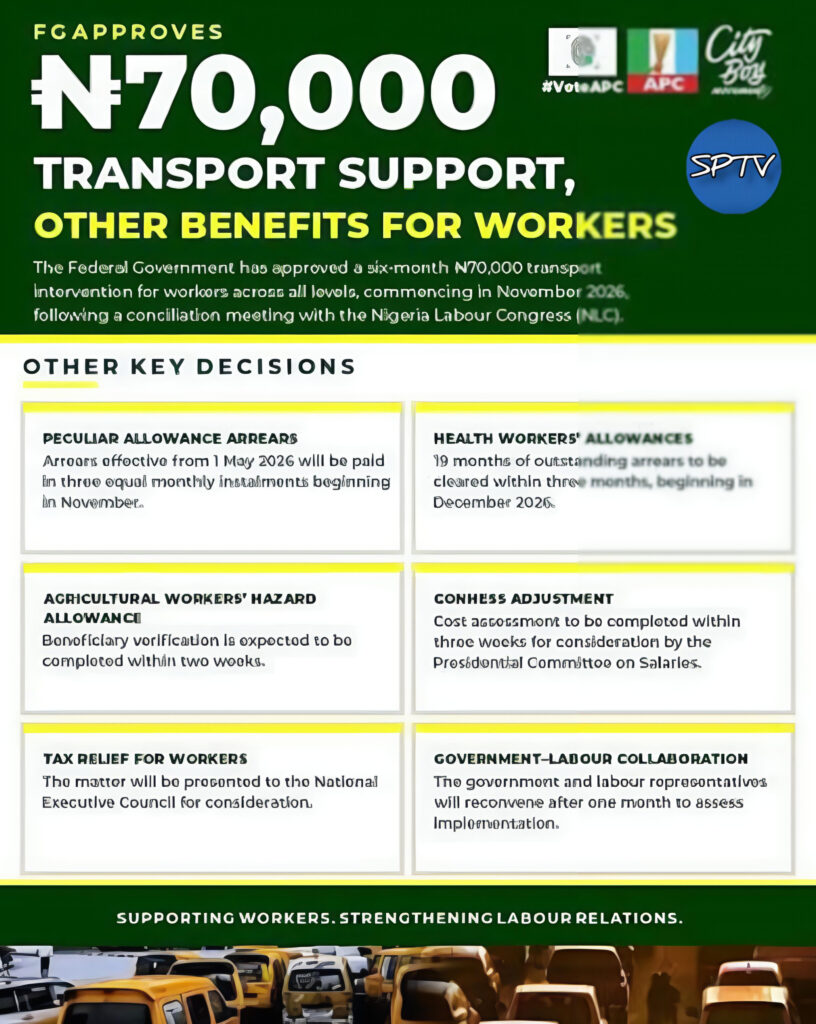
The Federal Government has approved a ₦70,000 monthly transport allowance for public service workers for six months, beginning in November 2026.
The agreement followed a conciliation meeting between government representatives and the leadership of the Nigeria Labour Congress (NLC) in Abuja on October 27, 2026.
The intervention is designed to provide temporary financial support to workers facing rising transportation costs and wider economic pressure.
Under the agreement, eligible workers are scheduled to receive ₦70,000 each month from November 2026 to April 2027. A worker who receives all six payments would collect a total of ₦420,000.
The agreement also covers outstanding peculiar allowance payments and arrears owed to health workers.
However, the transport intervention is separate from the national minimum wage. The government and organised labour did not settle the effective date for implementing a new minimum wage arrangement during the meeting.
The Trade Union Congress (TUC) has also criticised the temporary support, arguing that workers need a lasting salary increase instead.
How the ₦70,000 Monthly Transport Allowance Works
The Federal Government approved the transport intervention for six months.
According to the memorandum of understanding reached on October 27, payments are scheduled to begin in November 2026 and continue through April 2027.
The agreed monthly amount is ₦70,000.
Workers who receive every instalment over the six-month period would collect:
- November 2026: ₦70,000
- December 2026: ₦70,000
- January 2027: ₦70,000
- February 2027: ₦70,000
- March 2027: ₦70,000
- April 2027: ₦70,000
The total over six months would be ₦420,000.
The allowance is a temporary intervention. The agreement does not establish a permanent addition to workers’ basic salaries.
The available reports also do not provide a specific monthly payment date or confirm whether the money will arrive alongside regular salaries.
Workers should therefore wait for official communication from their respective employers and relevant government offices.
Who Is Eligible for the ₦70,000 Transport Support?
The agreement followed negotiations between the Federal Government and the Nigeria Labour Congress.
Reports describe the intervention as support for public service workers, with the agreement referring to payments across all levels.
However, the exact implementation arrangements for state and local government employees require clarification.
Channels Television reported that state and local governments were encouraged to participate. Reuters also described the agreement as a transport allowance for federal government workers.
This distinction matters. The agreement should not be interpreted as automatic confirmation that every state and local government employee will receive the money.
The available reports also do not establish that private-sector employees qualify.
Workers should seek confirmation from their employers or relevant government authorities before assuming they are included.
The agreement does not announce a public registration portal or a separate application process for beneficiaries.
Why Did the Federal Government Approve the Allowance?
The transport allowance followed discussions about workers’ welfare and the rising cost of living.
Nigerian workers have faced higher expenses for transportation, food and other essential needs.
Organised labour had raised concerns about the pressure on workers’ incomes and outstanding welfare commitments.
The October 27 meeting provided an opportunity for both sides to discuss these issues and agree on temporary support.
The Federal Government’s ₦70,000 intervention is intended to help workers manage transportation expenses during the six-month period.
However, the allowance does not resolve every issue raised by organised labour. Discussions about the national minimum wage and other outstanding agreements remain separate matters.
Government Also Approves Peculiar Allowance Arrears
The October 27 agreement includes the payment of outstanding peculiar allowance arrears.
The payments will take effect from May 1, 2026.
The government agreed to settle the accumulated arrears in three equal monthly instalments, beginning in November 2026.
This arrangement is separate from the ₦70,000 transport allowance.
Workers who qualify for the peculiar allowance should therefore distinguish between the two payments when checking their entitlements.
The agreement provides for arrears to be settled over three months. It does not mean every worker will receive the full accumulated amount in November.
The payment schedule is intended to spread the outstanding obligation across three instalments.
Government Agrees to Clear 19 Months of Health Workers’ Allowances
The agreement also addresses outstanding allowances owed to health workers.
The Federal Government agreed to redeem 19 months of unpaid health workers’ allowances within three months, beginning in December 2026.
This commitment forms part of the wider discussions between the government and organised labour over workers’ welfare.
The agreement provides a timeline for settling the arrears, but workers will still need official implementation details to understand how the payments will reach eligible staff.
The health workers’ allowance arrangement is separate from the general transport intervention.
The meeting also addressed other labour issues, including minimum wage discussions and outstanding welfare commitments.
Minimum Wage Negotiations Remain Unresolved
Although the government approved the transport allowance, the October 27 meeting did not settle the effective date for implementing the national minimum wage arrangement.
The parties agreed to establish a Minimum Wage Negotiation Committee and begin discussions.
This means the ₦70,000 transport support should not be treated as a replacement for a permanent salary adjustment.
The two issues have different purposes.
The transport allowance provides temporary assistance over six months. Minimum wage negotiations concern workers’ regular pay and the broader wage structure.
The lack of an agreed implementation date means workers still need to wait for further announcements about the minimum wage process.
TUC Rejects the Temporary Transport Allowance
The Trade Union Congress of Nigeria has rejected the Federal Government’s ₦70,000 transport allowance.
The union argues that temporary wage awards do not provide lasting relief for workers facing rising living costs.
In its October 28 statement, the TUC called for an immediate salary increase instead of relying on a temporary intervention.
The congress also raised concerns about the implementation of an earlier wage award agreed upon in 2023.
According to the union, some workers did not receive all the payments under the previous arrangement, while others experienced irregular disbursements.
The TUC argued that workers need consistent salary improvements rather than temporary support with uncertain implementation.
The union also called on the government to address outstanding agreements involving health workers, including the adjustment of the Consolidated Health Salary Structure.
Its position shows that organised labour does not hold a single view on the latest agreement.
Public Service Negotiating Council Supports the Agreement
The Joint National Public Service Negotiating Council (JNPSNC) has defended the ₦70,000 transport allowance.
The council said the agreement followed negotiations between government representatives and organised labour.
It also argued that the TUC’s rejection would not automatically cancel the arrangement.
The council’s support highlights the disagreement among labour groups over the best way to address workers’ financial pressure.
While the TUC wants a more permanent salary increase, the JNPSNC has defended the negotiated transport support as a useful intervention.
The Nigeria Union of Pensioners has also criticised the exclusion of retirees from the proposed transport relief, according to reports from Radio Nigeria.
These reactions show that questions about the allowance extend beyond its value. Workers and pensioners are also concerned about who qualifies and how the government will implement the agreement.
When Will Workers Receive the First ₦70,000 Payment?
The agreement sets November 2026 as the start of the six-month intervention.
However, the available reports do not provide an exact date for the first payment.
They also do not confirm whether the allowance will arrive with workers’ November salaries or through a separate payment process.
As of November 8, 2026, the sources reviewed for this report did not provide independently verified confirmation of a completed first payment to workers.
The government and relevant public service authorities still need to provide clear implementation details.
Workers should follow official communication from their employers and government offices for updates.
They should also avoid unofficial registration links or messages requesting bank details, passwords or payment fees.
Does the Allowance Apply to Private-Sector Workers?
The agreement followed a conciliation meeting between the Federal Government and the NLC.
The available reports do not establish a requirement for private employers to pay the ₦70,000 allowance.
Private-sector employees should therefore not assume the intervention applies to them.
The agreement also requires further clarification on how state and local government employees will be covered.
Workers should confirm their eligibility through official employment channels rather than relying on general social media claims.
What Happens Next?
The six-month intervention is scheduled to begin in November 2026.
Attention will now turn to the government’s implementation process, including the identification of eligible workers and the timing of payments.
The government will also need to follow through on the three-month payment schedule for peculiar allowance arrears and the planned settlement of 19 months of health workers’ allowances.
Minimum wage negotiations are expected to proceed through the committee agreed upon during the conciliation meeting.
Labour groups will also continue to monitor whether the government fulfils its commitments.
For workers, the main issue is whether the approved support reaches eligible employees on schedule.
Final Thoughts
The Federal Government has approved a ₦70,000 monthly transport allowance for public service workers for six months, beginning in November 2026.
Workers who receive all six instalments would collect ₦420,000 in total.
The agreement also covers peculiar allowance arrears and 19 months of outstanding health workers’ allowances.
However, the transport intervention does not replace the national minimum wage, and the government has not provided a specific first-payment date.
Questions about state and local government eligibility also require clearer implementation guidance.
The coming months will show whether the government delivers the agreed support within the stated timelines.
Frequently Asked Questions
1. How much is the Federal Government’s transport allowance?
The approved transport intervention is ₦70,000 per month for six months, from November 2026 to April 2027.
2. How much will workers receive over six months?
Workers who receive all six monthly payments will collect ₦420,000 in total.
3. Does the ₦70,000 allowance replace the national minimum wage?
No. The transport allowance is a temporary intervention. The government and organised labour did not agree on the effective date for implementing the national minimum wage during the October 27 meeting.