

Alphabet shares suffered their worst single-day decline on record in late October 2026, wiping out roughly $500 billion in market value after investors reacted to weaker-than-expected results from the Google parent company.
The sell-off followed Alphabet’s third-quarter earnings report, released on October 28. Although the company reported revenue growth of 25% year over year, investors focused on weaker-than-expected advertising results, lower earnings, and the growing cost of its artificial intelligence investments.
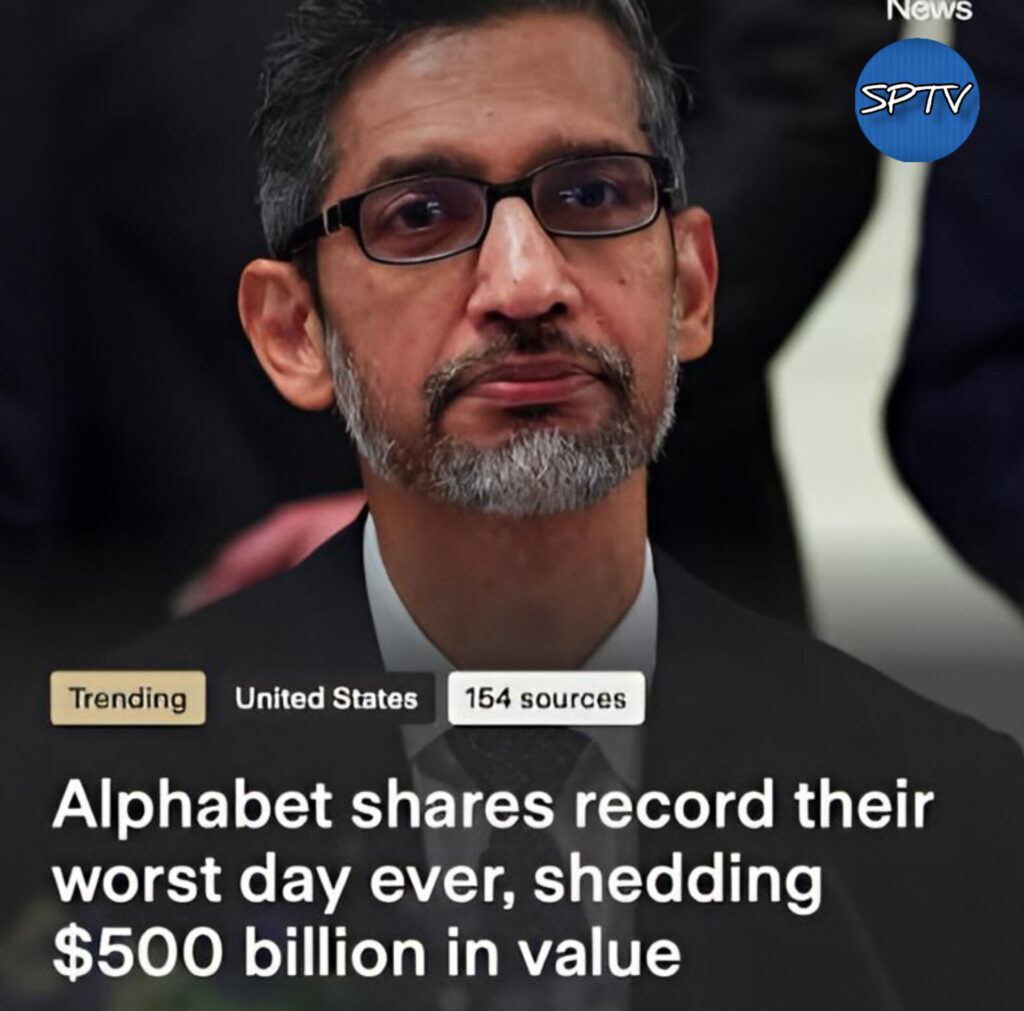
The sharp decline highlighted a key concern facing large technology companies. Investors want evidence that spending on AI infrastructure, data centres, and advanced models will generate enough revenue and cash flow to justify the cost.
Alphabet’s results showed strength in Google Cloud and continued growth in Search revenue. However, those gains did not fully ease concerns about advertising performance and the amount of capital required to support the company’s AI plans.
Alphabet Shares Lose Around $500 Billion in Market Value
Alphabet shares fell sharply on Thursday, October 29, after investors assessed the company’s latest financial results.
NBC News reported that the stock fell by as much as 15.8% during the session, putting the company on course for its largest single-day percentage decline. The fall erased more than $550 billion in market capitalisation at the intraday low.
Reuters separately reported that Alphabet shares fell 12.6%, wiping out approximately $500 billion in market value.
The figures refer to different points in the trading session. The larger decline reflected the intraday sell-off, while the Reuters figure described the market reaction around the close of trading.
The scale of the loss made Alphabet one of the biggest contributors to the wider technology sell-off.
A decline in market capitalisation does not mean the company paid out that amount in cash. Market capitalisation is calculated by multiplying the share price by the number of outstanding shares. When the share price falls sharply, the company’s market value also declines.
Alphabet remained one of the largest companies in the United States despite the sell-off.
Sources: NBC News reporting carried by NBC4 Washington and Reuters market coverage.
Alphabet’s Revenue Increased 25%, but Investors Expected More
Alphabet reported revenue of $127.6 billion for the third quarter of 2026, up from $102.35 billion in the same period of 2025.
The 25% increase shows that the company’s overall business continued to expand.
However, revenue came in below analysts’ expectations, according to Reuters and the Associated Press. The company also reported lower net income, adding to concerns about the financial impact of its AI investment plans.
Net income available to common stockholders declined to $26.17 billion from $34.98 billion a year earlier. Diluted earnings per share fell to $2.12 from $2.87.
Part of the decline reflected an $8.7 billion loss on equity investments, according to the Associated Press. This reduced reported earnings despite growth in revenue and operating income.
The results illustrate why investors assess more than revenue growth when valuing a company.
A company might generate more sales while experiencing pressure from higher expenses, investment losses, or changes in cash flow. Investors often compare reported results with market expectations because share prices reflect assumptions about future performance.
In Alphabet’s case, the company delivered substantial revenue growth, but the results failed to satisfy investors who expected stronger performance from its advertising business and clearer evidence of returns from its AI spending.
Source: Alphabet’s official third-quarter results and Associated Press reporting.
Search Advertising Raises Concerns About AI’s Impact
Google Search remains central to Alphabet’s business because advertising linked to search activity generates substantial revenue.
For the third quarter of 2026, Google Search and other revenue reached approximately $63.35 billion, up from $56.57 billion a year earlier.
That represents growth of around 12%.
However, the increase fell short of what some investors expected. NBC News reported that Alphabet executives pointed to the effect of Google’s AI Mode feature, which offers AI-generated responses to search queries.
AI Mode changes how users interact with search results. Instead of relying only on a traditional list of links, users receive AI-generated answers and additional information within the search experience.
This creates opportunities for Google to make Search more useful and retain users. At the same time, it raises questions about how the company will display advertisements and generate revenue from AI-driven searches.
Traditional search advertising often places paid results alongside a list of links. AI-generated responses may change where advertisements appear, how users interact with them, and how advertisers measure their value.
During Alphabet’s earnings discussion, executives acknowledged that AI Mode was affecting advertising activity. The company also said experiments involving advertisements in the feature had shown promising results.
The issue for investors is whether Alphabet will find effective ways to monetise AI-driven searches without weakening the economics of its established advertising business.
The company has not said that AI Mode will replace traditional Search. Instead, the challenge is to develop new search experiences while preserving the revenue that supports a large part of its business.
Sources: NBC News reporting and Alphabet’s quarterly financial disclosures.
AI Spending Raises Questions About Future Returns
Alphabet’s investment in artificial intelligence was another major concern behind the stock’s decline.
The company has committed substantial resources to computing infrastructure, data centres, energy, chips, and other systems required to develop and operate AI products.
Alphabet’s capital spending plans have increased as demand for AI computing grows. Reuters reported that the company expected capital expenditure of approximately $195 billion to $205 billion in 2026, with spending expected to rise further in 2027.
NBC News also reported that Alphabet had committed to more than $1 trillion in multi-year spending agreements related to AI infrastructure, energy, and leases.
These figures show the scale of the company’s investment plans, although spending commitments over several years should not be confused with cash payments made in a single quarter.
AI infrastructure requires significant upfront investment. Companies need computing chips, buildings, electricity, networking equipment, and technical staff before they earn revenue from the resulting services.
Alphabet is spending to support its own products, including Gemini, AI features in Search, and enterprise services offered through Google Cloud.
The company is also selling AI infrastructure and services to other businesses. This creates a possible source of revenue from customers that need computing resources to develop and operate their own AI systems.
Investors, however, want to know whether revenue from these activities will grow quickly enough to justify the investment.
If spending rises faster than cash generation, the company could face pressure on free cash flow, even if reported revenue continues to increase.
Google Cloud Delivers Strong Growth
Google Cloud was one of the strongest parts of Alphabet’s third-quarter results.
Cloud revenue increased 103% year over year to approximately $30.71 billion from $15.16 billion.
The company attributed the growth to demand for AI infrastructure, enterprise AI solutions, and its core cloud services.
Cloud computing allows businesses to access computing power, storage, software, and other digital resources through online platforms. AI development has increased demand for these services because training and operating advanced models require substantial computing capacity.
Google Cloud also supplies infrastructure and specialised processors to businesses that need AI computing resources.
The strong revenue growth suggests Alphabet is generating commercial demand from companies investing in AI.
However, investors also examine how much profit and cash flow this growth produces. Rapid expansion requires spending on infrastructure and equipment, which affects the cost of serving customers.
Alphabet reported Google Cloud operating income of approximately $11.12 billion for the quarter, compared with $3.59 billion a year earlier. This shows that the business’s operating performance improved alongside revenue.
Google Cloud’s growth provides an important counterpoint to the concerns surrounding Search advertising.
The company’s challenge is to turn its broader AI investments into durable earnings while managing the costs of operating its expanding infrastructure.
Source: Alphabet’s official third-quarter financial results.
Alphabet’s AI Business Continues to Expand
Alphabet has continued to introduce AI products across its services.
The company highlighted strong adoption of its Gemini app, which reached one billion users, according to its third-quarter earnings announcement.
Alphabet also reported that its first-party model APIs were processing nearly 32 billion tokens per minute, more than four times the amount processed a year earlier.
Tokens are units of text or other data processed by AI models. The figure indicates the scale of usage across the company’s AI services, although token processing volume alone does not show how profitable those services are.
Alphabet is using AI across Search, cloud computing, productivity services, and other products.
The company has also invested in its own AI chips, known as tensor processing units, or TPUs. These processors support AI workloads and provide another part of Alphabet’s computing infrastructure.
This combination of AI models, chips, and cloud services gives the company several ways to generate revenue from the technology.
However, the rapid expansion of AI also increases the need for capital spending. Investors must assess whether the additional revenue from these services will justify the costs of building and operating the infrastructure.
Why Investors Reacted So Sharply
The market reaction reflected a gap between Alphabet’s business growth and investor expectations.
Revenue rose 25%, and Google Cloud more than doubled its revenue. Search revenue also increased. These figures do not describe a company whose entire business is shrinking.
Instead, investors focused on weaker-than-expected advertising performance, lower net income, and the financial demands of the AI buildout.
Large technology companies often trade at valuations based on expectations of future earnings and cash generation. When results fall short of those expectations, share prices may decline even when revenue continues to grow.
Alphabet also faces uncertainty about the long-term economics of AI-powered search.
If AI features encourage users to spend more time on Google’s services, they might support engagement and commercial activity. But if AI-generated responses reduce the number of traditional advertising opportunities, Alphabet will need to develop effective new ways to monetise those interactions.
The company is working on advertising formats for AI Mode, but investors will want evidence that these formats generate meaningful revenue.
The stock’s decline shows that strong AI adoption does not automatically satisfy investors. They also want evidence of sustainable returns.
What Alphabet’s Sell-Off Means for the Technology Sector
Alphabet’s share-price decline added pressure to the wider technology market.
The Nasdaq Composite fell during the session as investors reassessed the costs and potential returns of AI investment. Shares in chipmakers and other companies connected to data-centre construction also came under pressure.
The reaction shows how closely the market links large technology companies to the AI investment cycle.
Alphabet is a major buyer of computing infrastructure and a major provider of AI services. Its spending plans influence demand for chips, data centres, electricity, and networking equipment.
When investors question the returns on those investments, concerns may spread to other businesses involved in the same supply chain.
However, one company’s share-price decline does not prove that the entire AI sector is weakening.
Different companies have different cost structures, products, and business models. Investors need to examine each company’s financial results rather than assuming that all AI-related businesses face the same risks.
For Alphabet, the immediate challenge is to demonstrate that its AI spending supports sustainable revenue, stronger margins, and reliable cash generation.
What Happens Next for Alphabet?
Investors will watch Alphabet’s next financial updates for evidence that Search advertising can meet expectations and that AI spending is generating sufficient returns.
Important indicators include advertising revenue growth, Google Cloud profitability, capital expenditure, free cash flow, and earnings.
The company will also need to show how AI Mode can generate advertising revenue while maintaining a useful search experience.
Strong growth in cloud computing and Gemini adoption provides potential sources of future revenue. However, the cost of operating these services will remain important.
Alphabet’s share price will also respond to broader market conditions, competition, and investor expectations about AI.
The late-October sell-off does not determine the company’s long-term performance. Future results will provide more evidence of whether the market’s concerns were justified.
Final Thoughts
Alphabet’s record share-price decline in late October 2026 reflected investor concerns about advertising performance, lower earnings, and the cost of its expanding AI business.
The company reported $127.6 billion in third-quarter revenue, up 25% year over year. Google Cloud delivered particularly strong growth, while Search revenue also increased.
However, the results fell short of some market expectations. Investors also reacted to the company’s investment requirements and questions about how AI-powered search will generate advertising revenue.
The loss of roughly $500 billion in market value shows how sharply expectations can change when a major technology company reports results that disappoint investors.
Alphabet still has substantial revenue sources and a growing AI business. Its next challenge is to demonstrate that its AI investments will produce returns that support its valuation over time.
Frequently Asked Questions
1. How much market value did Alphabet lose in late October 2026?
Alphabet lost approximately $500 billion in market value during the late-October sell-off. NBC News reported an intraday loss exceeding $550 billion as the shares fell by as much as 15.8%.
2. Why did Alphabet shares fall despite revenue growth?
Investors reacted to weaker-than-expected results, lower net income, advertising concerns, and the cost of Alphabet’s AI investments. Revenue increased 25%, but the results did not meet all market expectations.